
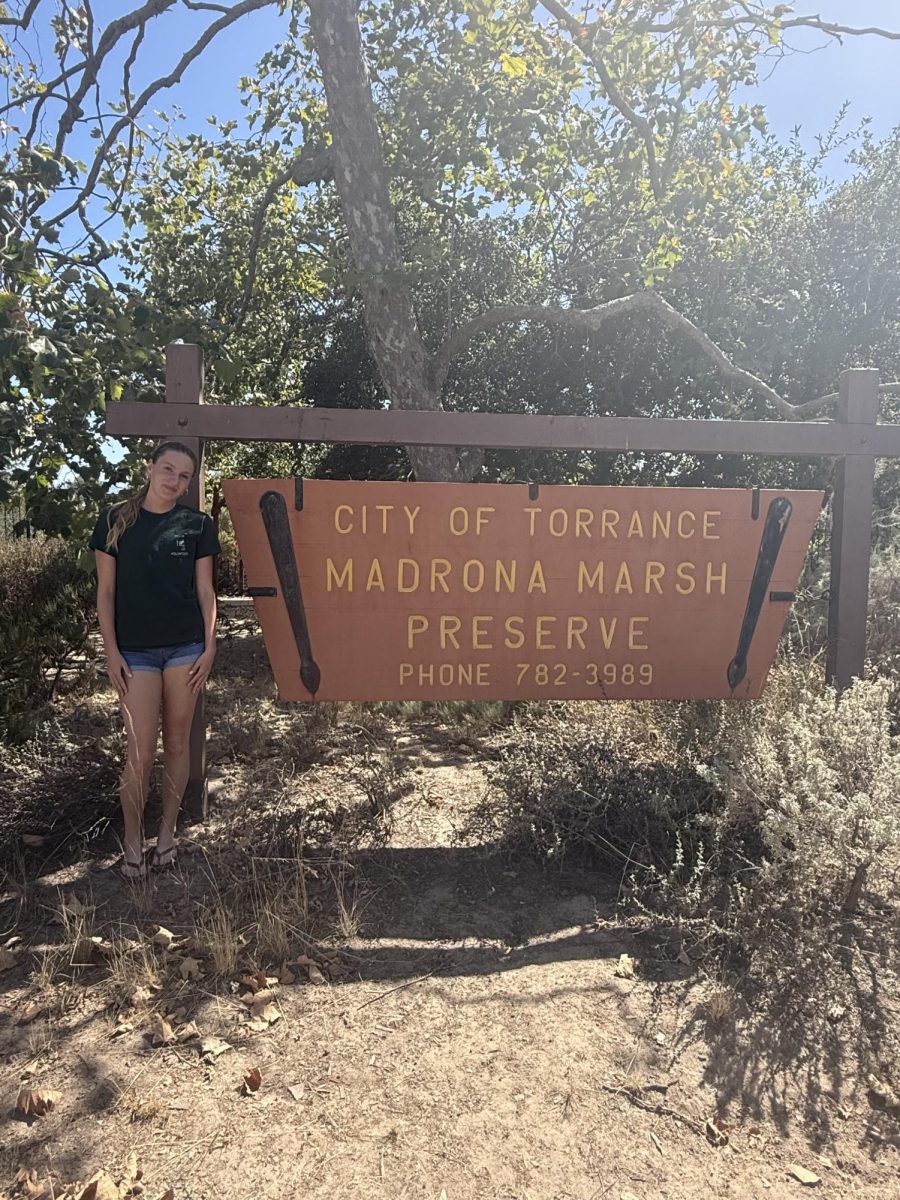
Along with her recent commitment to the University of California, Davis for environmental engineering, Hayden McMahon has been a leader in RUHS’s sustainability community since her junior year. McMahon is currently president of the AP Environmental Science tutoring club and a volunteer for the Madrona Marsh Advanced Restoration Crew, but has been developing her passion for the environment for several years.
“In seventh grade, I took an Energy and Sustainability class. It was my second choice at first, but I honestly ended up falling in love with it. I found the material so interesting, and taking that class helped me realize that environmental science was really something I was interested in,” McMahon said.
McMahon “unfortunately didn’t have the opportunity to get back into that passion” until taking AP Environmental Science (APES) her junior year. While most of the material covered was similar to what she had learned in middle school, she found APES “even more interesting” because of the college-level detail involved in the course.
“Once I actually started the class and got super invested in it, it made me debate what I wanted to major in for college. I’ve always loved the humanities, but taking [APES] helped me realize that a slightly more STEM related field would be just as amazing to pursue,” McMahon said.
McMahon’s APES teacher, Gillian Moberg, has watched McMahon’s involvement in environmental science grow, from having McMahon as a student to watching her tutor and support her peers as president of the APES Tutoring Club her senior year.
“What I like about Hayden is that she is patient and positive. When she is helping others, she’s not condescending because she enjoys the process. She’s a genuinely generous person,” Moberg said. “As a student, she applied the same philosophy to herself, in that she was very generous and patient with herself. She worked hard, and was never afraid to try again when she made a mistake.”
As someone who has observed McMahon’s growth, Moberg is able to speak to how McMahon’s qualities will help guide her through her environmental engineering major.
“Hayden is definitely a leader. I don’t think she’s going to college just to learn to follow. I could always tell that she was a genuinely curious student, and that will get her very far,” Moberg said.
The curiosity Moberg speaks to was especially prevalent for McMahon when learning about sustainable energy and some of the more math-focused topics in APES, and this interest eventually helped her choose her major.
“I’ve always loved math, and I love the problem solving aspect of [environmental engineering]. As challenging as I’m sure it will be, I feel like it’s such a rewarding career to pursue,” McMahon said. “Environmental engineering also relates to civil engineering and takes you into the planning of sustainable urban areas, which I think is really important because everyone has a right to live sustainably.”
McMahon is also looking forward to the multitude of opportunities UC Davis offers that align with both her major and what she is looking for in a college campus.
“One of the biggest subjects at Davis is agriculture, and they’re in a really nice area where they’re able to be super sustainable and put emphasis on that,” McMahon said. “I visited the campus, and on every corner, there is some sort of device or system that is enforcing sustainability; it’s amazing. They’re also ranked in the top 10 for environmental engineering in the country.”
In addition to the scientific aspect of it, McMahon’s passion for environmental issues also comes from an understanding of what humans gain from mitigating them. In college, she is looking forward to fostering this understanding and sharing it with others.
“I understand people not being as invested in the environment as I am,” McMahon said. “But even if you don’t see a tree and want to go up and hug it, you certainly want fresh food to eat and clean water to drink. So, even if you don’t have complete adoration for the planet, at least respect it.”