


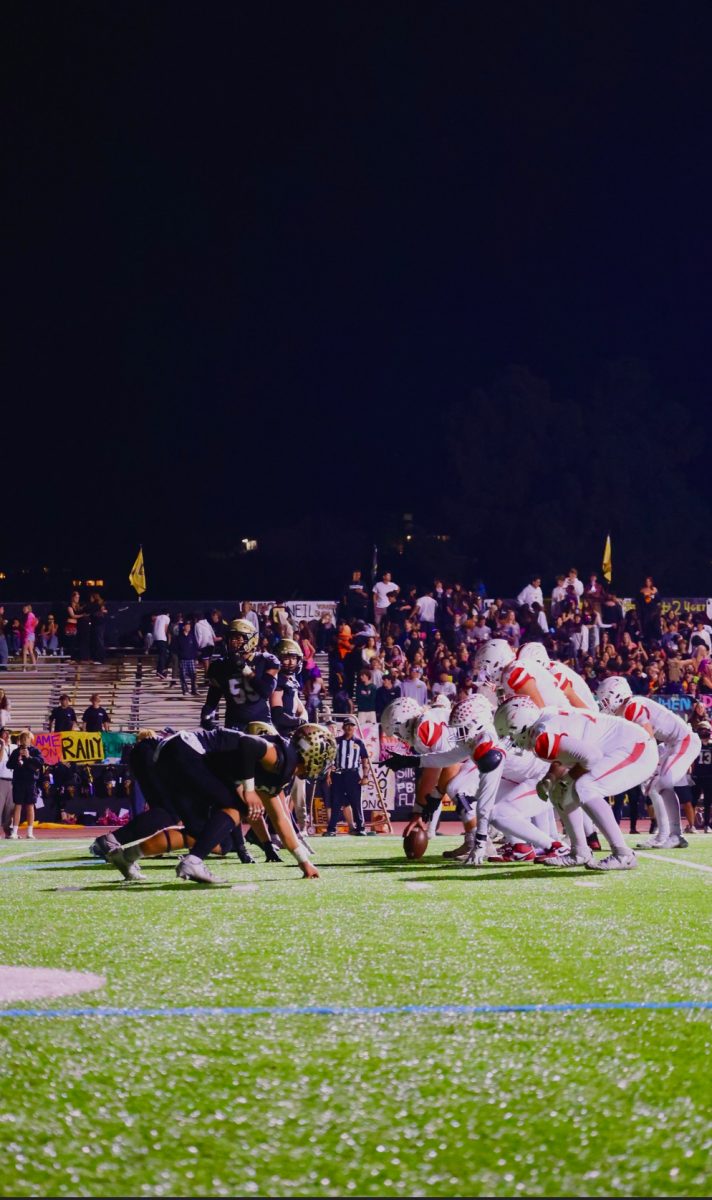
Standing at over six feet tall with broad shoulders, Francisco Villegas looks like a football player—and for the past three years, Villegas has played as an offensive lineman on the RUHS boys football team. Despite the “massive impact” football has had on Villegas’ high school experience, going into freshman year, he never expected that he would end up on the team.
“Growing up, I did Little League baseball and a year of soccer, and then in fifth grade I did basketball. But I was never a sports fan at all compared to my brother. I genuinely wasn’t interested as much, and I was bored [on the field]. [Sports] were never my thing, I was more into superheroes,” Villegas said.
Villegas was first drawn to football in the second semester of his freshman year after the fall season had already ended, when his friend Bryson Garcia encouraged him to join the team. Although he initially worried that he would have to “manipulate [himself] into someone” to fit in with the guys on the team, Villegas eventually “found a love for football” and developed “a brotherhood” with his teammates.
“Going into [football], I couldn’t have told you anything. I came into meetings and I didn’t understand the terms they were using. My coach prepped me for that, that I wasn’t going to know anything. It was just a learning experience. But eventually you fall in love with it,” Villegas said. “It’s fun seeing the guys you spend so much time with succeed, and it’s fun pushing each other to be better with such a unified goal.”
In addition to football, Villegas has also been a member of journalism since his sophomore year, and has contributed to the program as an online sports editor for the past two years. He views journalism as an important field that “really brings value to society.” His fellow sports editor, Sam Schwartz, became one of Villegas’ first and closest friends in the program after they first met.
“I’ve edited a few of [Villegas’] stories, and he has a really good grasp on how to write sports stories. To be honest with you, he’s written some of the best stories I’ve ever seen. He finds the perfect balance of everything, whether it’s background information to game commentary and the emotions that the players have,” Schwartz said. “There was a lot of creativity in the graphics that he made, the knowledge he had on how to use words to encapsulate an image or a specific moment of a story. He came a really long way and this year he changed the game a little bit in our sports department.”
Due to his involvement in both journalism and football, Villegas was required to manage his time, balancing his commitments as well as his grades, particularly as football became a “time suck” for him. During the season, Villegas attended practice after school on Monday through Wednesday, games on Friday, and took a zero period before school to practice and lift weights. While Villegas appreciated his time with the program, he also felt the pressure that football placed on his personal time and as he prioritized football as the culture in football pushed him “to place [the sport] above all.”
“Earlier this year, [Villegas] would always talk about how little time he had outside of class and how little personal time he had to himself. I think it was hard to balance stuff like the gym, and stuff that he wanted to personally do himself, because in football, they have zero period lifts and they push you to do what the program wants or has set for their players. A lot of that stuff with friends got cut off because he had to wake up early in the morning and Friday games are so late,” Schwartz said. “After football season [was over], I saw a different Francisco, a rejuvenated self. I saw that he spent more time with his friends and he’d be really, really happy all the time. It was really eye-opening to me that a sport can take up so much of your time.”
Despite being set up to play as a starter on the varsity boys football team in his senior year, a knee injury limited Villegas to “hobbling around” and kept him on the bench for the majority of the season. However, despite the personal loss, Villegas labeled the season a success for the team overall, and “a story [he] could be proud of” as it became the first time in 81 years that RUHS’ football team made it to the California Interscholastic Federation (CIF) championship game. In order to continue to support his team, Villegas focused on the roles he could fill off the field, like energizing his teammates.
“I put a lot of effort into trying to be as good a teammate as possible, even in that limited role. Be loud, try to get people to be high energy and contribute however I can. And then from there because of that attitude change for the team as a whole, we were able to succeed as a team once we got into the playoffs,” Villegas said. “I think that even though personally it was a failed season, there was still a lot of value in it and it’s something I reflect on a lot.”
Although Villegas’ football career is coming to a close, he intends to continue to explore sports journalism in the future and take the skills he has learned through both programs with him beyond high school.
“Football-wise, I’ve found an end where I think I went everywhere I really wanted to go with the program. I got everything I wanted to do out of football. I loved the brotherhood and learning and pushing myself in something that I had no experience in and learning that I can do that, entering a new field,” Villegas said. “And I think going forward, even though that’s not my focus, it’s a type of effort and mentality, that ‘I’m gonna keep going’ [mindset] that I can use for whatever I do in the future.”