


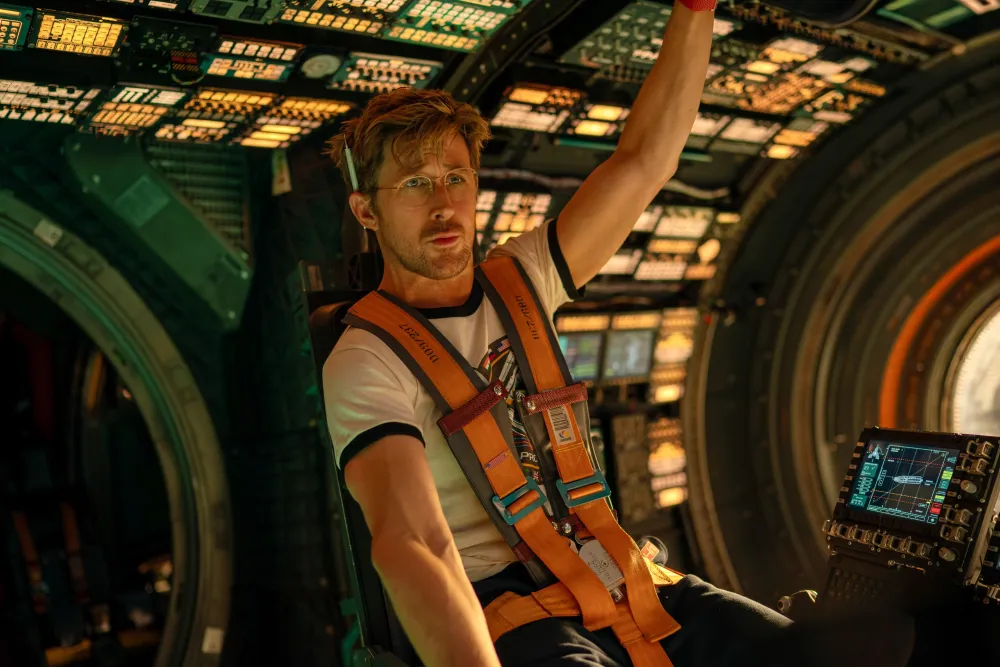
I would never make it as an astronaut. If just watching “Project Hail Mary” alone had me crying four consecutive times in the theater, mildly regretting inviting a friend and thanking movie theaters for being so dark, I can’t imagine I’d ever be able to make it with NASA. Just hearing the speed of light mentioned triggered painful memories of Advanced Placement Chemistry. Leave the fate of the world to someone else. Thankfully, “Project Hail Mary” does.
“Project Hail Mary,” directed by Christopher Miller and Phil Lord, was released on Mar. 20 and is based on Andy Weir’s novel of the same title. The movie stars Ryan Gosling as Dr. Ryland Grace, a former middle school science teacher turned astronaut who wakes up on a spaceship several light years away from Earth with no memory of how he’s gotten there or what he’s meant to do. With his fellow crewmates dead, Grace is left to slowly puzzle out his mission as his memories begin to return, revealing that Earth is currently facing an imminent climate disaster. A living substance called “astrophage” has been eating away at the sun, dimming its light to a point that temperatures will drop ten degrees in thirty years and end up killing at least a fourth of the world’s population as agriculture and every other human industry collapses. The same is happening to all other suns in close proximity except for one, and Grace has been given a one-way-ticket to investigate the exception and send home a solution that will save humanity. The movie, like the book, abides to the laws of hard science fiction with a strong basis in real physics, biology and chemistry, and so easily the most unbelievable part of the story is that a group of the world’s leaders would successfully come together to address a climate crisis.
One element of the movie that immediately struck me was its strategic use of visual storytelling. I’m a sucker for some good cinematography, and Oscar-winning cinematographer Greig Fraser, known for his work on both “Dune” movies as well as Matt Reeves’ “The Batman,” did not disappoint. Grace’s initial confusion and disorientation is showcased clearly through constant cuts as the angle switches every few seconds, and I appreciated the dynamic camerawork throughout the movie. Color also created a stark visual contrast between flashbacks from Earth, particularly vibrant when Grace is teaching and growing bleaker as he goes on to become more and more involved with the project, and the current timeline aboard his spaceship. And while most of the scenes in space are primarily made up of shades of black, gray and white, distinct pops of color like Grace’s signature red spacesuit are sprinkled in which ends up creating some interesting composition, especially during pivotal moments in the movie. The use of light in particular also stood out to me, especially considering its relevance to the story and plot. Illumination and visibility drops in moments of panic and chaos, while Grace constantly attempts to bring light back into the film.
Notably, a large portion of the movie’s success hinges upon Ryan Gosling’s acting and likability. As more than half of the movie is spent focusing almost entirely on Grace, the only human left on his mission, it would be easy to lose interest if he were boring or obnoxious. Thankfully, Gosling portrays Grace with his usual charm and the writing is humorous while still allowing Gosling to display a wide spectrum of emotions as Grace processes both the responsibility weighing on his shoulders and the prospect of his inevitable death alone in space.
I also appreciated the movie’s atmosphere (or lack thereof) and how it portrays space itself, particularly through audio. At certain moments where Grace has left the ship or is exploring unknown territory, sound drops out entirely, leaving either complete silence or the sound of Grace breathing, like it actually would in space. Music in space scenes, when present, is most often choral or hymnal, ironic considering just how deeply isolated Grace is in these scenes.
My one critique with this movie lies in some of the convenient jumps in logic or plausibility that led me to pause while watching it. Although Grace is shown to be quite intelligent, particularly in his field of expertise, his innate ability in other areas seems sketchy at best. Grace hasn’t undergone training as an astronaut, yet faces no major difficulties in adjusting to space. He’s able to (somewhat shakily) pilot a spaceship and communicate with aliens lacking a shared language with the aid of computer programs and some English lessons. These aspects of the story lack the same consideration and attention that’s been given to more science backed facets. This relative ease in navigating the large environmental shifts Grace faces allows us to focus more on the larger themes of the movie but also seems overly convenient in some cases and tries my suspension of belief.
Otherwise, the writing toes the line between humor and tragedy well, keeping an even balance. While the movie starts off relatively light, the gravity of Grace’s circumstances counterbalanced by his dry humor and sarcasm, it eventually delves into deeper themes such as companionship, responsibility and consent. Watching Grace form genuine relationships with the constant reminder that he has been sent on a suicide mission creates a sense of suspense and haunts the viewer throughout the movie. Safe to say, “Project Hail Mary” will at no point leave you bored.
So as long as you’re willing to let a few leaps in logic go, I’d recommend “Project Hail Mary” without hesitation. A theater would probably provide the best viewing experience but I’d expect a dark room equipped with some blackout curtains to work as a fine substitute as well. Just be sure to snag some tissues and brace for impact.