
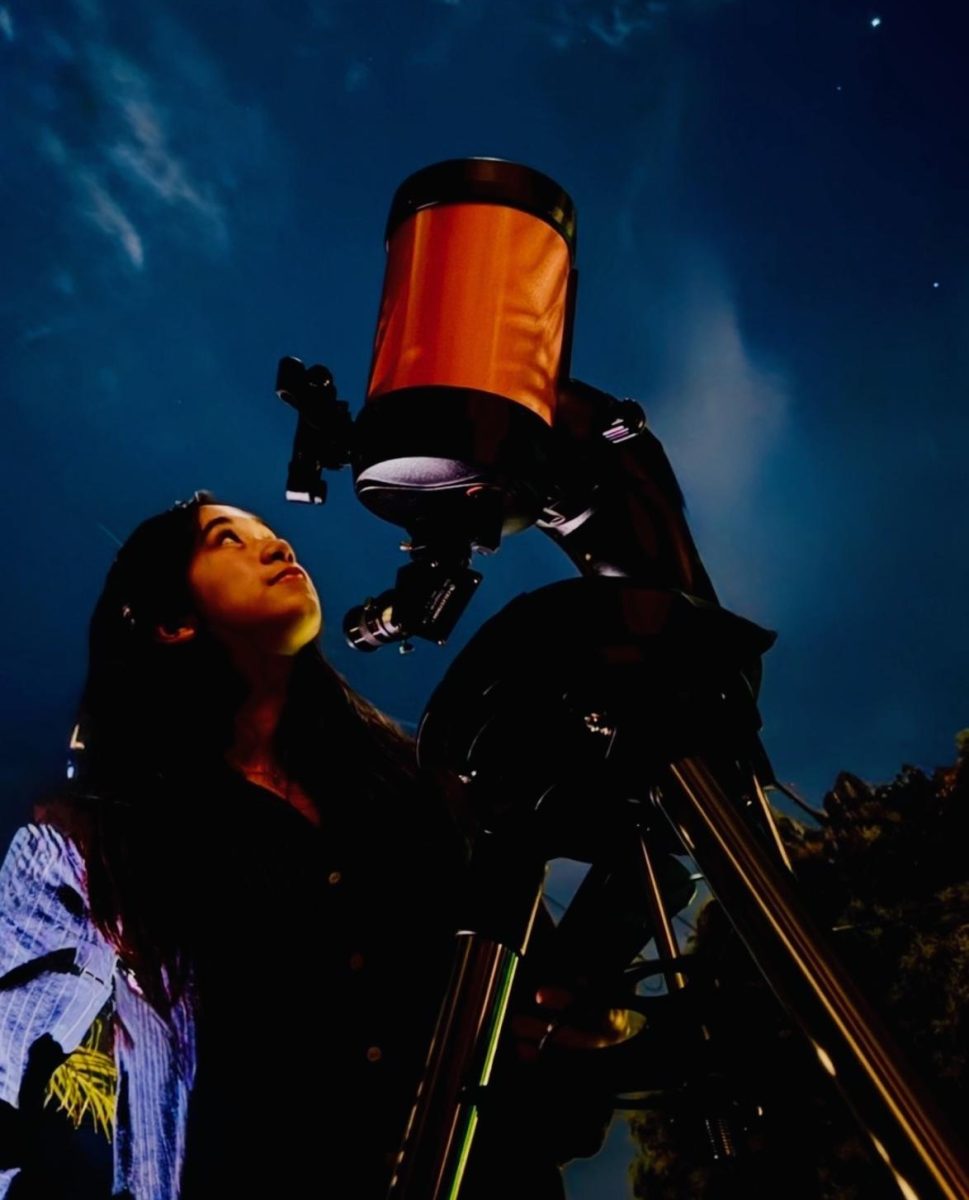
At 2 a.m., while most of California was asleep, sophomore Bella Engleman and her mom were wide awake in the middle of the pitch-black San Diego desert, looking up at the sky above them through a lens. Unlike in Redondo, here the night sky was clear, free from light pollution. Above her the sky looked painted by constellations, an image she would later recall as “surreal.” After telling her friends this story, they urged her to create an astronomy club at Redondo, so that they too could understand and appreciate the galaxy above them. The newly-established club aims to break down social barriers with the hope of providing both current and future students with access to education in STEAM (Science, technology, engineering, arts, and math).
“I feel like there’s some status quo, where, when you think of a rocket scientist, people don’t usually envision women, or they think that while a girl can do it, it’s a lot harder, which shouldn’t be true. If we get more people involved in STEAM, especially women, we can break that status quo,” Engleman said.
Science education is something that Engleman firmly believes should be accessible to all. Along with providing intellectual stimulation, it is something that connects people as a whole. Stories and knowledge surrounding space have been passed down throughout generations, and efforts like Engleman’s will continue that tradition.
“It’s just so breathtaking that this is what the ancient Greeks saw, and everyone before me. Astronomy is so timeless because you’re seeing the same things people have seen before you, but also, [it reminds you that] we’re so insignificant in the grand scheme of things. There’s that one Carl Sagan quote, where ‘if the entire universe was a calendar, we would be the last few hours on December 31st,’” Engleman said.
Space manifests itself in many lenses. While it causes some students, like Engleman, to reflect on their place in this universe, others view it as a less abstract concept, connecting it to the content they learn in their academic courses at school, and engaging with it in a new way thanks to their understanding of astronomy.
“It’s really gratifying and cool to have something that you’re learning about in school apply to the club. When we learned about Galileo, everyone ran into our club, and said, ‘guess what we were doing?’ It was just so cool,” Engleman said.
While space has been studied throughout history, it is not something to be left in the past. In modern day, issues with our atmosphere and new innovations in technology have brought space to the forefront of innovation, creating an even higher demand for understanding of the subject.
“Space is the future. We definitely do need to figure it out because it’s a big thing now with space exploration and everything. It’s cool to get more people interested in it because I feel like literacy and knowing about that is super important,” Engleman said.
During regular meetings, students and board members alike are invited to research and present different aspects of astronomy. While the nature of the club is laid-back, space innovation is far from it, so there are constantly new ideas to be discussed, an aspect of the club which is heavily appreciated by Engleman’s fellow sophomore and the Astronomy Club’s Vice President, Nika Mostofi.
“There’s a lot of unknown about space, and the different science in astronomy, all of the questions and theories are really interesting,” Mostofi said.
While the members of the club are still learning themselves, they take initiative in teaching other community members about the information they discuss in meetings. Their outreach extends not only to fellow RUHS students, but to the next generation as well.
“We really want to help students get into astronomy more. We went to Tulita’s STEAM night, where we taught little kids and did fun activities with them about astronomy, and it was really cool seeing them learn new things. That’s a big part of the club, we get to teach but also learn new things,” Mostofi said.
Astronomy is constantly expanding as a field, opening up new opportunities for this and future generations to study, and a place for everybody at the table of STEAM.
“The field of astrology is so versatile. Anything you’re interested in, you can fit it in astronomy because no matter how much you know, you can always know more. Textbooks change every few days because we’re constantly finding something new,” Engleman said. “Whether you’re an amateur, and you have a telescope in your backyard, or you work at NASA, there’s really something for everyone.”