
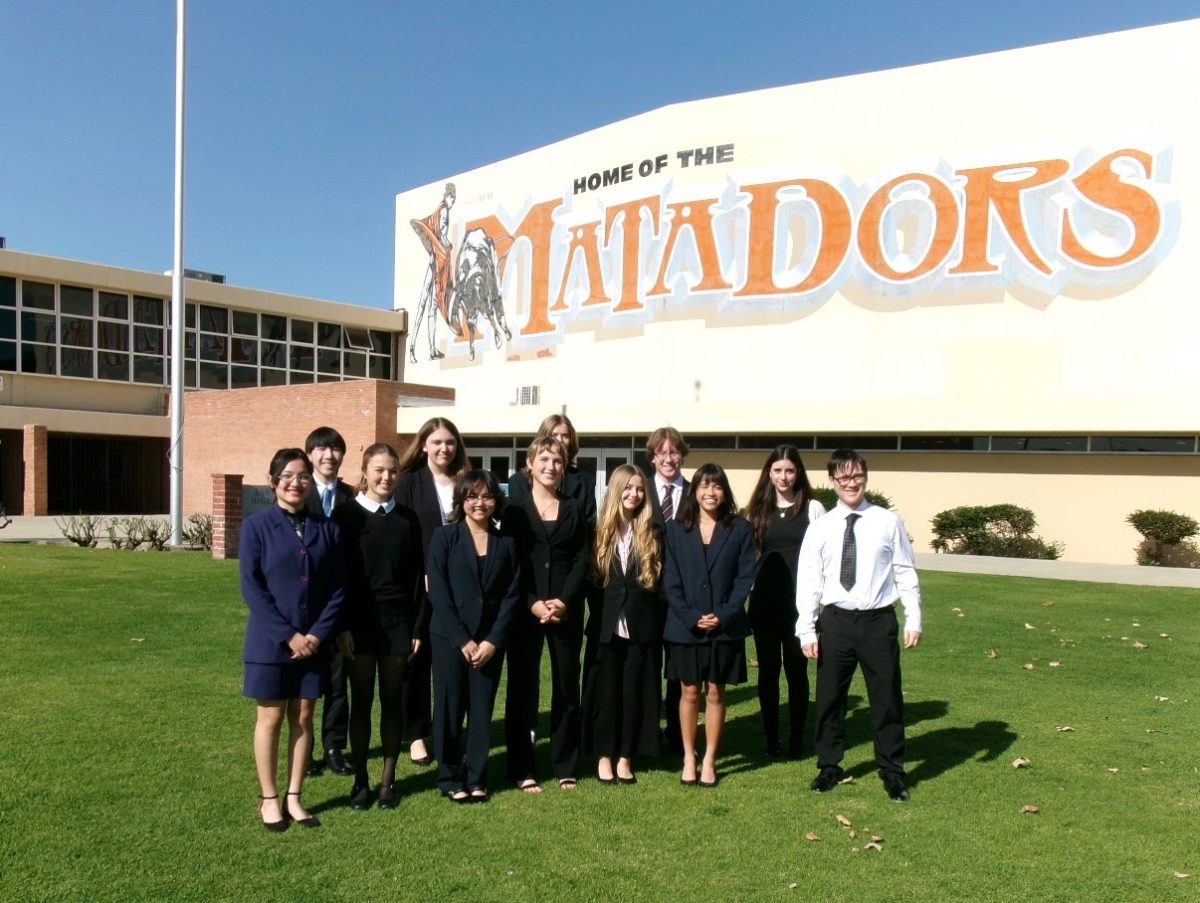
Excitement is buzzing through the air, overwhelming any lingering nerves – the bus to San Gabriel High School is packed with students dressed in professional attire, confident smiles, and eager minds. In a field of 61 of LA County’s most competitive schools, the RUHS Academic Decathlon team secured a top-ten finish on Feb. 19, ranking 7th place at the regional competition. The competition itself began on Jan. 24 and concluded on Jan. 31.
Academic Decathlon, otherwise known as AcaDec, is a rigorous, team-based competition for high schoolers, often described as a “varsity sport of the mind.” Knowledge extends across 10 disciplines: art, economics, literature, math, music, science, social science, speech, interview and essay, all revolving around a central theme — this year’s theme being the roaring ‘20s. The competition begins at the regional level, then advances to the state level, and finally, to the national level. Jackson Lee, an RUHS senior and coach on the AcaDec team, describes the composition of the tests and what the competitors must be prepared to do.
“Typically for the competitions, especially for regionals, they do a lot of essay practice, and they give out their speeches and interviews: the subjective parts,” Lee said. “They [also] do a lot of objective testing, so they will be given multiple choice tests for science and math, and it’s our job as coaches, since we don’t compete, to read the curriculum and condense it in a way that helps the team understand the materials that are being tested on and help them get their scores up so they can make it to state.”
According to senior Antonia Kozis, an AcaDec competitor, one notable strength of the RUHS AcaDec team is their ability to lean on one another’s shoulders and tap into the collective knowledge of their peers to enhance their own proficiency across all 10 subjects.
“Fortunately, we have so many skilled people on our team who can specialize in subjects that they are personally interested in, and can then, from there, help everyone else on the team get up to speed with those subjects,” Kozis said. “So, really, what practice looks like in the lead-up to competitions is everybody coming together and helping each other out.”
Though the team can utilize their supporting community to improve in areas of difficulty, there are still some struggles, especially from subject to subject. That’s where coaches like Lee come in to provide resources and study guides for struggling competitors.
“I tend to cover more of the math subject and also the art subject because math is honestly one of the subjects that a lot of people struggle with,” Lee said. “I try to focus more on the math area as much as I can in order to help them understand where they are, and with the subjects that they’re struggling in.”
According to Lee and Kozis, many of the team members and teachers were skeptical coming into this year’s competition after they had just missed the cutoff the previous year, but to make up for their shortcomings, the team was able to raise its score from around 35,000 points to 42,000 in this year’s regionals, enabling them to move forward to the state competition.
“Honestly, I felt pretty confident that the team was going to make it to state just because we were focusing more on the objective side than subjective, [and] our team is very strong in the subjective,“ Lee said. “I think [7th was] very strong place because ultimately, the goal was to make it to state. So whatever the placement was for Redondo to make it to state is a good position to be in.”
From the conclusion of the regional competition on Feb 19 to the beginning of the California State competition on Mar 14, the team has dedicated much of its time to preparation, though Kozis notes that it is impossible to cram for an academic sport like AcaDec.
“What that looks like on a typical day-to-day is setting apart that extra couple of hours a week to dive into the subjects that you may struggle with or that you know you need review,” Kozis said. “Because we have access to our regional scores, we can individually see a formal reference for what we personally need to prepare for.”
Many people are not even aware of AcaDec’s existence, Kozis herself included before she joined the team. Despite its rigor, both the competitors and coaches of the team find it to be an enjoyable experience and a challenging sort of fun. Kozis urges not to let the initial or preconceived intensity deter anyone interested from joining, and to keep an open mind to what AcaDec entails.
“It’s kind of a hard sell,” Kozis said. “But what I’ve found to be the most valuable aspect of Acadec is that A, it creates a community that is sort of uniquely centered around learning, and B, it is largely student-led. I personally can’t think of another academic setting in which I fully get to explore that side of the subjects I’m interested in to the capacity with which I’ve gotten to explore those in AcaDec.”