
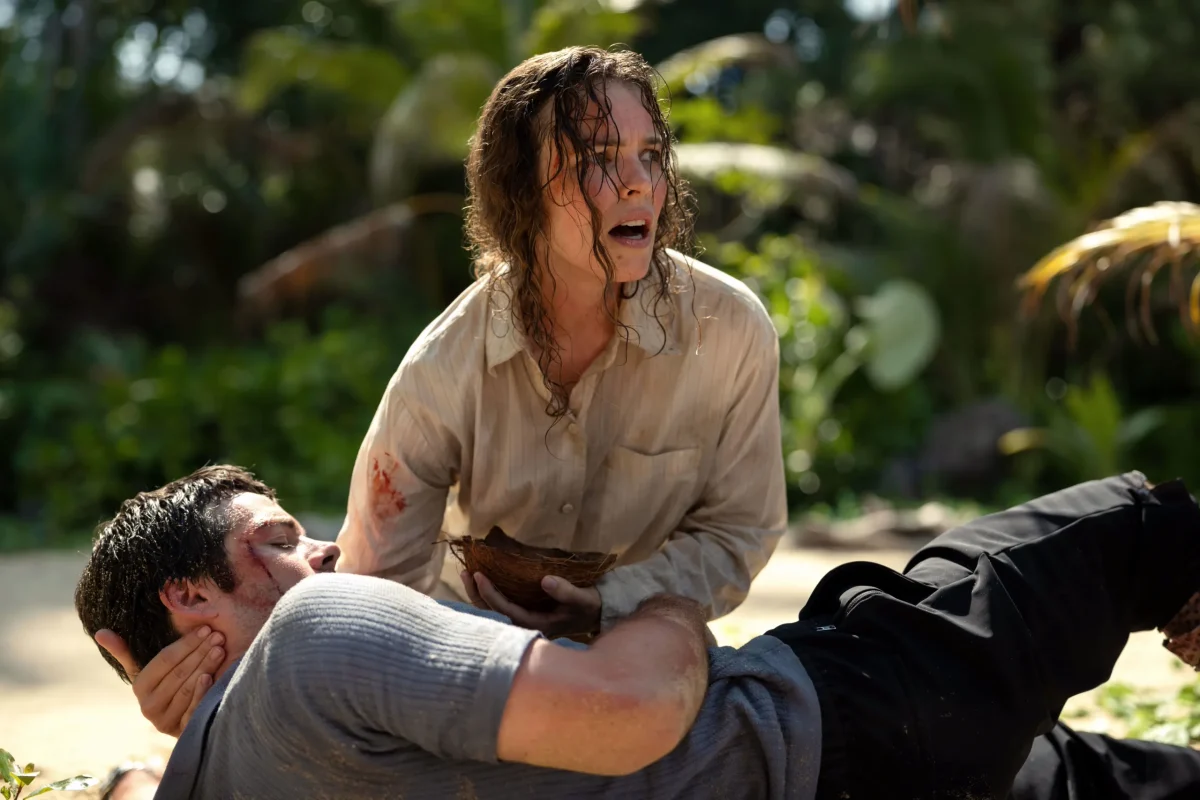
Send help! Not to the characters on screen, but to my brain for the emotional rollercoaster this movie put it through. At 11 in the morning, I found myself lounging on the South Bay Galleria AMC’s reclining seats, munching on some very overpriced and greasy pizza bites, and watching Sam Raimi’s new film “Send Help.”
Honestly, I didn’t have the highest hopes for this movie while walking into the theater. The marketing of the movie was very different compared to the content in it. I was expecting a ‘working together to survive’ situation, something like what Hollywood has historically pushed out in the past, with characters adhering to the strict gender binary. I was expecting a cliche love story between the two main characters, with a muscular male lead that saves his small and helpless ‘damsel in distress’ colleague, but I was pleasantly surprised. I was absolutely not expecting a strangely hilarious, yet grotesque movie with overarching themes of gender politics, the glass ceiling and misogyny, with ‘you reap what you sow’ jokes jumbled into the mix, which grew my appreciation for the weird, confusing yet oddly lovable movie.
When the movie started, I felt generally frustrated. Linda Liddle (Rachel McAdams) works in the Strategy and Planning department of her company, where her character is portrayed as this single cat lady archetype. This disgusts her male chauvinist new boss, Bradley Preston (Dylan O’Brein), a raging misogynist who essentially nepo-babied his way to the top of the company.
The film uses interesting choices of cinematography to show her bosses’ disapproval of Linda, through close-up, almost 0.5-esque shots. I feel the tactic was mainly utilized at the beginning of the movie to display comedic timing to highlight the lighter, more unserious atmosphere. It was used first when Linda had a spot of tuna on her mouth, eliciting laughter out of not only me, but the rest of the audience.
I felt the humorous approach of the movie appealed to more than just comedy. This tactic helped to solidify the portrayal of Bradley’s character as a misogynistic bigot who is more inclined to respect women he personally finds physically attractive. Him focusing on the spot of tuna on her face, instead of caring about what she’s saying like a good boss would, highlights his sour personality, as he focuses on her physicality over how much of an asset she is to the company. Every time this guy opened his mouth, spoke, or was even on screen, I wanted to strangle this character, so props to Dylan O’Brien for playing this irritating jerk so well.
In this toxic work environment, we see men taking credit for Linda’s work time and time again, and she’s repeatedly targeted and humiliated for her awkward and sociable personality. Even after following someone who took her work as his own, and seeing him presenting “his” findings in a meeting, she is positively tenacious. I felt myself really sympathizing and even empathizing with her awkward, yet lovable character in the beginning of the movie, as she’s overlooked and undermined constantly despite her working so hard and diligently.
Throughout the movie, I did notice a few tributes and references to outside media that happily surprised me. There was a music choice of Mean Girls songs, from “One Way or Another” by Blondie, and “Rip Her to Shreds.” In addition to that, Linda randomly finds a conch, waggling it around and exclaiming that she found it in a what seemed to be “Lord of the Flies” reference.
I did enjoy how the movie gave Linda this position of power that made Bradley rely on her. He went from a spoiled, cocky frat bro that basically had every opportunity spoon-fed to him, to this guy who had to come to terms with not having power in a situation. Because Linda had extensive knowledge of how to survive in the wilderness, it was satisfying to see Bradley have to beg and come to terms with what a misogynistic prick he’s been to Linda, and I thoroughly enjoyed this section of the movie.
There was a scene where Linda hunts a wild boar, and the Computer Generated Imagery [CGI] in this scene looked so cheap and poorly made that it made the scene lose value for me, even though it was almost supposed to be a liberating or empowering moment. This scene was supposed to act as a pivotal turning point, but it fell short.
Sam Raimi, the director of the movie, stayed true to his classic tools of gore and vomit, cut through by comedic moments, much appreciated on my part. As someone who is definitely not a big fan of gore or horror, I was grateful for this type of storytelling. Although my hands were over my eyes, these scenes were often punctuated with timely jokes that made the whole audience cackle with laughter.
My love-hate relationship with this weirdly endearing movie confuses me. When Linda and Bradley were on the island together, there were weird and off-putting sexual and romantic scenes between the pair. I watched these scenes with disgust, as I thought the movie wanted to romanticize Bradley’s performative “change of heart” to push the pair together in an overdone cliche. ‘Oh boo hoo,’ I kept thinking. In this life-or-death situation, Bradley was being nicer to Linda and losing his misogynistic superiority complex. It annoyed me that the movie was almost pushing the pair together and I felt that at times it praised him for the bare minimum.
Really Hollywood? I’m glad the movie showed and highlighted these strong themes of workplace misogyny and the glass ceiling, so it’s pretty progressive in that aspect. The movie felt feminist because of this, however, I feel it did so in a straight cut, white feminist way, as its issues were centered on a white woman being overlooked – which I of course empathize with – but lacked an intersectional perspective that would have added other important facets to the movie and made it a better social commentary, since it was so focused on swapping gender roles, and issues women commonly face in the workforce.
But why do these movies have to rely on white straight characters for it to sell, with some side characters that are people of color, for the sake of diversity, just for them to die off and be used for the main characters to build resentment toward one another? For a movie with the main premise of defying stereotypical gender roles, karma and what I’m sure people on the internet could label “female rage”, the movie could have been so much more impactful if it didn’t rigidly push feminism into a small box. It doesn’t have to be this way.
As someone who’s usually good at sniffing out plot twists and predicting what’s going to happen, this movie did an amazing job at keeping me on edge and leaving me to question and wonder what’s going to happen next. I’d recommend this film to anyone looking to watch in unease, and cover their eyes from unexpected gore scenes, all while enjoying a good laugh.