

Adverse Academics



The College Board has administered over 100 million Advanced Placements [AP] tests to high school students since 1955, according to a report released by the College Board. Last year, the 1,259 AP students accounted for 44 percent of the total enrollment at RUHS, and 2,697 tests were administered for the over 20 AP classes offered. These tests are a chance for students to demonstrate high levels of proficiency within a chosen subject and receive college credit by earning a score of three or higher out of five on the test administered every May.
There are, however, different types of advanced classes being explored as options to integrate at RUHS. One such program is Cambridge International, offered in over 160 countries, an international pre-university curriculum that originated in the United Kingdom as part of Cambridge University over 160 years ago. Like AP, Cambridge involves standardized testing for each subject, but it has both AS and A Levels, which are one and two yearlong extensions of the same subject, respectively. Last year, RBUSD Superintendent Dr. Nicole Wesley attended the inaugural U.S. Cambridge PreK–12 Advisory Committee meeting. She then asked Principal Marvin Brown, teacher Kitaro Takesue and Executive Director of Educational Services Roy Lopez Jr. to attend a Cambridge conference over the summer and learn more about the program.
“One of the biggest differences between Cambridge and AP is that it is more applicable learning,” Brown said. “The learning that students do with AP is a lot of memorization. There’s some writing, but more memorization. Cambridge is more [about] applying things. […] Another distinction is how many credits you get for their highest level course, the A level courses. They get more college credit at international schools, state schools, private schools and public schools than AP courses do. Obviously, there’s the international credit that you get access to if you complete those courses, [which] as opposed to AP, you don’t. There’s lots of things that I think make it unique and I think it’s gonna be a program that continues to grow, especially within California, and we want to be [at] the forefront of that.”
There are two Cambridge exams each year in November and June. These exams range from $115 to $220, compared to the $99 fee for an AP exam that are more easily waived for low-income students. While AP tests are a mix of multiple choice and free-response questions, Cambridge exams are essay-based and require greater critical thinking and analysis, contributing to the perception of Cambridge exams as more rigorous than AP. In some cases, this may make Cambridge exams more similar to the style of assessments in college. At Florida State University, a study was conducted between 2016 and 2019 on students that took AS and A levels. 73 percent of former Cambridge students achieved an A in their subsequent college course compared to the 49 percent of all students that earned an A. Approximately 92 percent of students who scored an E, the lowest passing score, on their A/AS Level went on to achieve an A or B grade in the relevant subsequent course in college.
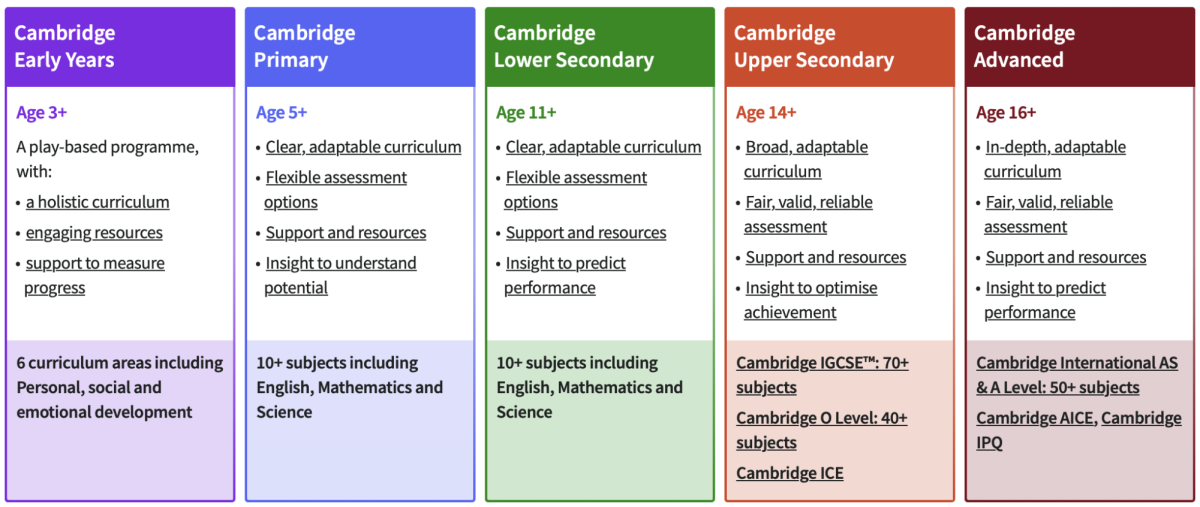
“It’s a different kind of a test, and so that poses its own [benefits] and challenges,” Takesue said. “[It’s like how] the SAT and the ACT exist at the same time. Some students do better on the SAT than the ACT, and vice versa. […] In some ways, [Cambridge classes] are harder. It’s also a culture shock because you have to learn a new set of vocabulary. We have a particular set of academic vocabulary for how we teach writing and what the expectations are for rubrics, et. cetera, but you’d have to learn all of the United Kingdom vocabulary for the test. When we’re still trying to align how we talk about writing and the vocabulary that we use for writing within our school site, it adds just another challenge of having students adapt. Students are adaptable, and it is possible.”
After attending the conference, Brown also took Takesue and other department heads on a site visit to Troy High School in Fullerton, California, which offers AP, International Baccalaureate and Cambridge classes to its 2,428 students. According to Takesue, who teaches AP English Literature at RUHS, some high schools have been able to integrate both the AP and Cambridge curriculum into one advanced class that prepares students for both kinds of tests, and they can select which one to take at their discretion, which is an option for classes like English where the standards are more likely to be similar between programs. Though new curriculums would need to be created, it is something that teachers are always working on.
“Many teachers are constantly revamping our curriculum, improving, looking at what we’re doing, reflecting, adapting and doing professional development over the summers,” Takesue said. “Many of us are bold and courageous, and look forward to opportunities to take a hard look at what we’re doing, and ask, ‘how can we do this better?’ We’re in the process of adopting new curriculums all throughout the district, and so these kinds of things happen regardless of whether a new class comes in or not. At the same time, our school district has set aside funds to support us anytime there’s a curriculum change to be able to teach it and teach it well. We’ve been given hours over the summer to work on it, to reflect on our practice, to have training from the different groups, and be paid for our time to be able to develop and adapt the curriculum that we have to meet, whatever the standards or skills or concepts that Cambridge is asking for us to cover. ”
Cambridge classes could also be offered separately from AP, which has the potential to bring new subjects of advanced classes to RUHS that are not offered by AP. Cambridge has 55 subjects, including what are currently unweighted electives at RUHS like Drama and Business, subjects not currently offered like Islamic Studies and Law, and different languages like Portuguese, German and Afrikaans. According to Brown, the 11 Cambridge classes listed in the survey are based on classes that RUHS teachers have expressed interest in teaching.
“In order for this to work, you have to have teachers that are interested in teaching the courses,” Brown said. “If our teachers make it happen, then it’s going to happen. If they want to teach the courses, and they go through the training and then we become a Cambridge school, our teachers should be recognized for that.”
While the expansion of different classes presents new opportunities to students, former University of Pennsylvania Assistant Director of Admissions and college admissions consultant Jayson Weingarten suggests that from a college admissions standpoint, just because a school offers multiple advanced programs does not necessarily mean taking both is the best course of action. Weingarten also denies that any one program will increase admission odds.
“Every school is going to have its own curriculum,” Weingarten said. “I don’t think that admissions officers favor AP as a curriculum versus International Baccalaureate as a curriculum versus Cambridge versus any other national curriculum there might be in countries around the world. That being said, there’s always going to be a most rigorous path. Students who are looking at the most highly selective schools are really encouraged to take the most difficult rigor and the most demanding coursework. […] Inherently, one versus the other is not going to be an important nuance, but if you’re at a school that does offer multiple of the different educational systems, I recommend not mixing and matching. Pick one and stick with it. […] In general, I think students that favor STEM and that side of the brain generally do better within the AP curriculum, and students that favor the humanities generally do better with the International Baccalaureate or Cambridge. Now, that being said, if you’re a history person and you only have AP in front of you, know that you’re not at a disadvantage.”
When it comes to class selection, Weingarten advises students and families to “be realistic with themselves.” Currently, Redondo counselors do not recommend students take more than three advanced classes per semester, including Honors, AP, and community college classes, but there are many students that far exceed this limit every year. Adding another, more difficult program could push self-driven students to sign up for more than they can handle.
“When we’re talking about stress, do we want to add in an even more rigorous test or series of exams that go across two years?” Takesue said. “That’s the thing in terms of what our priorities are. At what time do we say, we need to protect kids from themselves and from the obligation to take really rigorous schedules? What is the cost of this psychologically and emotionally? […] I’m of the mind to say that we’re doing a wonderful job as a district of supporting and giving opportunities for students to take AP exams. We have a really high pass rate, so why mess with something that is already doing stellar? We could look at this as an opportunity to ask ourselves what we can do to support students in terms of their mental health and in terms of their ability to take on the load that they’re already taking.”
Last year, RUHS’s AP pass rate was 96 percent, compared to the national average of 60 to 75 percent reported by the College Board.
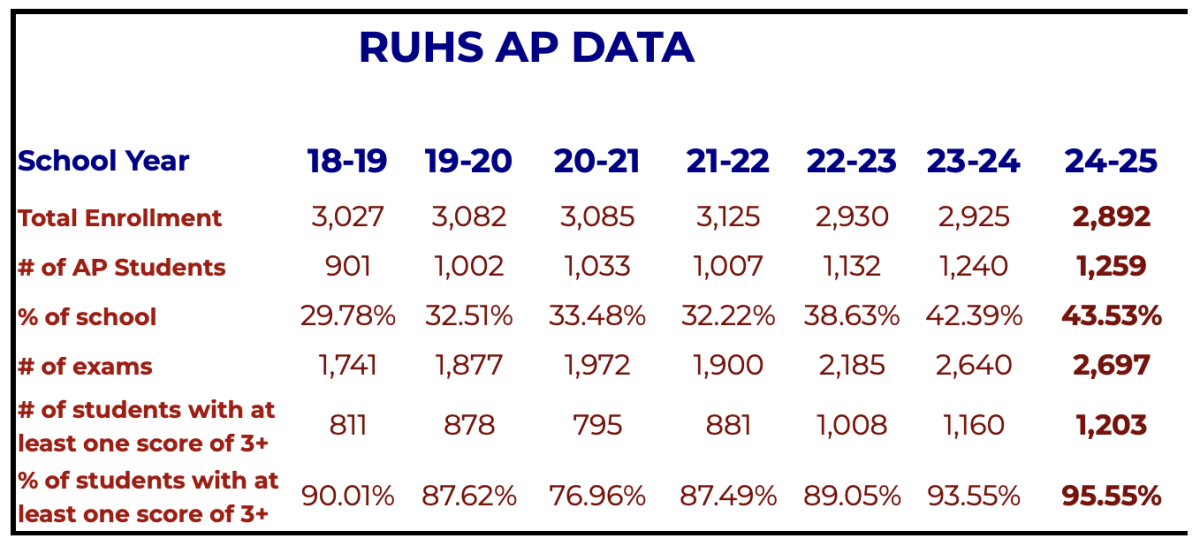
“When I look at how we do on AP exams, and we’re at a 96 percent pass rate out of 2,700 tests, that tells me that we have kids that are smart and that they would be successful in Cambridge,” Brown said. “I think that’s the best indicator to determine success. If we had an 85 or 75 percent pass rate on the AP exams, I would say maybe Cambridge probably isn’t the right fit for us. If we have 75 percent of our kids getting a three or higher on an AP test, that number’s just gonna go down on a Cambridge test. But, if we have 96 percent getting a 3 or higher on an AP test, my assumption is that they’re going to be successful. And it’s not just what I think, it’s what the Cambridge folks think. When we’re talking to Cambridge, they’re looking at the demographics of the school, the data of the school, the AP pass rates, how many courses we have; there’s so many metrics that they look at, and they wouldn’t suggest it and we wouldn’t offer it if we didn’t feel like our kids could be successful.”
However, it isn’t just offering another option for students that are performing well in AP classes that is driving the push to bring Cambridge to RBUSD. The district’s enrollment has been steadily declining since 2019, dropping from 10,123 students to 9,560 students as of last year.
“The number one motivation is just to separate ourselves from other school districts to increase our enrollment,” Brown said. “Most public school districts right now in Southern California have declining enrollment.. A lot of that’s just because real estate prices are going up and families aren’t either moving in because of that, or they’re just not having children. There’s more online options now than ever and there’s more private schools that are competitors that maybe haven’t been in the past. There’s lots of different things that have happened since COVID that have made it hard to keep our enrollment numbers high. We want to add programs that are different from other school districts to attract more families to RBUSD.”
If and when Cambridge classes will be making an appearance on RUHS course selection sheets remains unknown. Still, RUHS already has a score of ‘A+’ on Niche.com, a popular site for choosing schools and neighborhoods.
“What are the things that make Redondo such a special school?” Takesue said. “It’s the extracurricular activities that we have. It’s the robust sports programs that we have, the cultural clubs that we have. When you think of what RUHS education can give somebody as opposed to going to another school or going to a private school, it’s the big school experience. We are an amazing school, and we do have all of these robust programs, and we do have a tremendous student life, and student activity programs here, and that’s what makes our school really special. When I first stepped foot on campus, and I saw how much pride students had, and how dedicated they were to showing up to events, and going to the games, and supporting each other, I thought that was an amazing thing. I think if we’re trying to really bring kids in, we should be promoting the things that we’re already doing, because we’re already a great school.”
After coming home from a tennis match, sophomore Amandine Schott becomes overwhelmed as she goes over the work she has to complete in her head: two tests to study for on top of an honors chemistry review and AP calculus worksheet plus reteaching herself French.By midnight, she’s become too exhausted to finish it all and shuts down because of the workload.
The 1.2 million other students taking AP classes across the country (according to College Board), can probably relate to the pressure and exhaustion Schott felt in this moment. At Redondo alone, 2,892 students are enrolled in these college level courses, designed to challenge students.Kathleen Pham, a senior who has 13 APs under her belt , expected and welcomed the challenging environment.
“My decision to take AP classes was based on me wanting to challenge myself, especially in subjects I’m not that comfortable in. I knew that it would help me being [in an] environment where everyone is really smart and really motivated,” Pham said. “[The environment] adds to the pressure because everyone in there wants to do well and wants to succeed. To deal with the competition I had to realize that everyone’s so different and on their own path, [so] there’s no point in comparing yourself.”
While this competitive environment can be beneficial for some students, Redondo Union Counselor Eva Ziss-Patton believes it is important to be realistic with course planning. She sees some students sign up for an unrealistic number of challenging classes because they believe they will be much more focused in the future than they are now, which can have negative consequences for those students.
“There are students that I’ve seen absolutely crumble because they take on too much. I think some students aren’t realistic about how much time or effort [AP classes] take. A lot of us have a tendency to not be as nice to our future selves as we are with our present self. I see students do that with APs a lot,” Patton said, “Some students have the tendency to sign up for every AP, which some students can manage, but not everyone can. I think we can do anything, but we can‘t do everything, and it’s important to keep that in mind.”
Taking AP classes does require a noticeable amount of sacrifice. Pham’s enrollment in AP classes has caused her to give up some of her previous hobbies like reading and going on walks, in order to keep up with studying and homework. This makes taking these hard classes “not attainable for the average student,” according to Pham.
“Junior year, I took physics, chem, and calc at the same time, [and] that was a large work load because not only did [I] have to stay focused in class, but outside of class I had to do a lot of learning on my own,” Pham said. “Especially if you have a job or [participate in] sports, doing homework and studying for tests takes up a majority of your afternoon. You go to school and you have to stay focused the entire day, and then you have to go home and continue being focused. I don’t really know how I did that.”
These difficult classes not only take up a lot of extra time, but can leave students exhausted by the end of the day. This extra exhaustion can leave less free time to hang out with friends as well as take you away from your hobbies.
“Most of my life is school now. I know most of the people in CP classes have more of a social life than I do, so I don’t know if they’d be willing to sacrifice that for the schoolwork that you would have to do for [AP] classes,” Schott said. “I don’t hang out with friends as often as I would like, but for me it is [worth it] because I want to go to a good college so I’m fine with making the sacrifice. It depends on your goals in life. If you want to live life fully, I wouldn’t say it’s worth it.”
Both Pham and Schott describe an imbalanced work-life ratio, which researchers at Sultan Qaboos University explain could lead to increased anxiety as well as “cognitive decline on indices of attention, concentration, learning, and remembering.” Balance can be hard to achieve in school, especially with increased pressure to succeed.
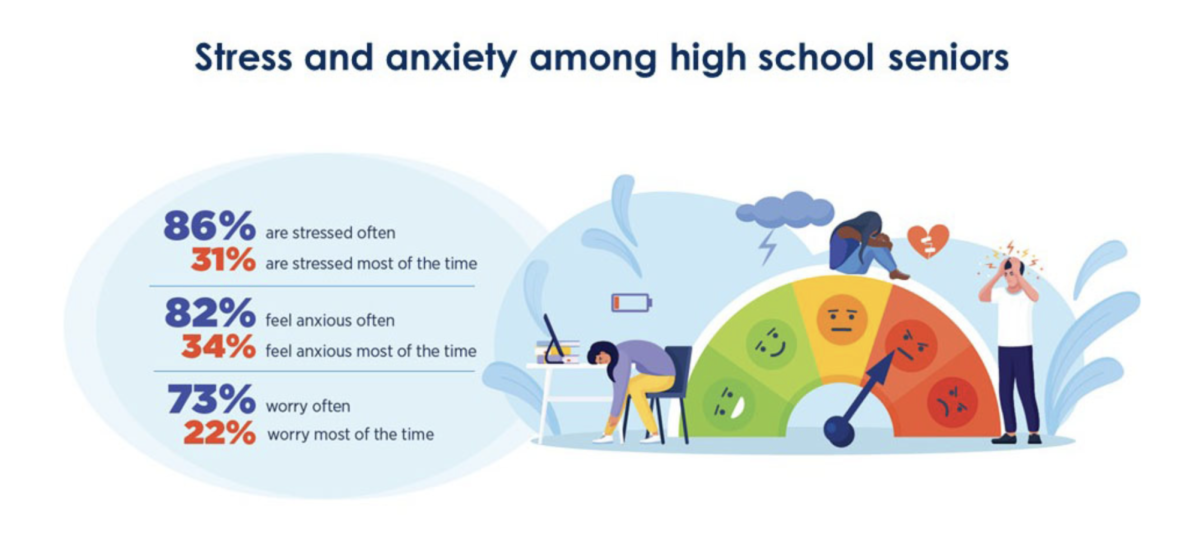
“I hang out with a lot of academically competitive people. If someone has a better grade than me, then I’ll feel worse about my grade, even if it’s good. I’ll tell myself, they did better, so I need to do better. So it can be competitive in a way where it’s a mental toll, but it also drives me to study more and work harder,” Schott said. Pham also faced burnout during her junior year due to the intense focus that was needed in order to maintain good grades and live up to her own personal expectations.
Pham also faced burnout during her junior year due to the intense focus that was needed in order to maintain good grades and live up to her own personal expectations.
“Second semester of my junior year was tough because I was so focused pretty much all of the year, especially because grades mattered a lot more,” Pham said. “But I think the important thing is a lot of balance. I think a lot of students put a lot of stress on themselves for every single test, but in the end it’ll all be okay. There will always be another opportunity to move your grade up, even if your grade isn’t where you want it to be, it doesn’t really matter in the long run.”
While keeping a positive attitude and a balance between school and personal activities can be hard, Patton explains how scheduling can also help with alleviating the stress that comes with difficult coursework.
“I think having a routine is very important. Be really honest with yourself about how long each task is going to take. Sometimes students think something is going to be a quick assignment and they push it off and then it ends up taking the whole night to finish. Be proactive. If you don’t have a lot of work one day, try to look over your notes or see if you can start studying in advance, so you don’t have days where you have nothing and days where you have a thousand assignments and soccer practice after school,” Patton said.
While there certainly are negative effects that come with taking hard AP classes, if students are able to find a healthy balance, these classes can help set them up for the future.
“It really depends on the student., There’s students who are able to manage multiple APs, and there’s other students who have a really tough time, so I think the most important part is knowing yourself and what you can manage. Some people spend an hour a day on their homework and they’re fine and other people are buried under work and it takes hours,” Patton said, “Being really honest about what you can manage, but also what you prioritize and value, and how important the class is to you can help you decide if the class is worth it or not.”