
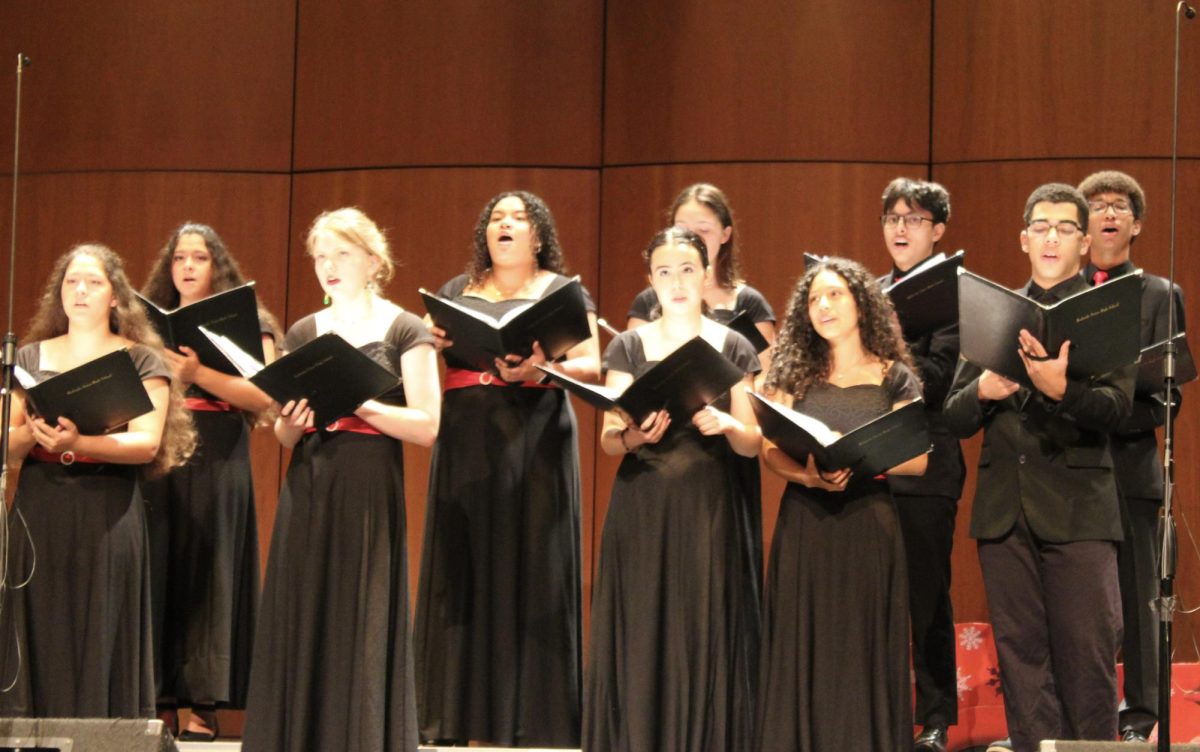
Without delay, students began to arrange themselves in neat rows along the auditorium stage, the lights dimming in response. With the seasonal spirit unraveling throughout the school halls, the choir welcomed the season with the annual winter choir concert.
At the performance that took place on the 17th, the choir program was in association with Tri-M, Acapella orchestra and even Adams Middle School’s choir, who were invited by Izumi Erskine, the RUHS choir teacher. The choirs and orchestra sang a wide range of holiday themed songs including ‘Santa Clause Is Comin’ to Town,’ ‘Jazz Waltz of the Sugar Plum Fairy’ and many more. In the spirit of being inclusive, Erskine made sure to include a variety of songs.
“[The concert] is about the celebration of holidays, not just Christmas songs. We actually did this one song that had original Hebrew in it. So it’s just a celebration of this season. It’s nice to have good music,” Erskine said.
According to junior Carlos Hernandez, people tend to have misconceptions regarding the choir as a whole and sometimes fail to recognize the work students are putting in to make the show memorable. As a vocalist in the concert, Hernandez puts in the time for practice before the event despite having a conflicting schedule due to wrestling.
“[People think] that [choir is] boring and [that] it’s a free class, [but] it’s not. You can’t just take it to take it [because] they still grade you on [your skills],” Hernandez said.
In addition, at this particular concert there was also an increase in the amount of songs sung by soloists. Soloists perform their own song alone on stage during the concert, which can induce a bit of anxiety for some students. Senior Patricia Amaya-Jackson had her own solo in the choir, ‘When You Believe,’ and faced her stage fright head on.
“Well, yeah, [it was nervewracking]. I have stage fright, so it doesn’t really help, but I try to move past it. I like how [in the theatre] it’s dark [where] the audience [is] so I can’t really see them. I just picture [the theatre] empty in my head,” Amaya-Jackson said.
Erskine can understand the fright of performing on stage, and relates to her students’ experiences.
“I always tell my students if that happens, close your eyes and take a moment. Nobody will blame you. You just [take] three seconds to inhale and exhale and that’s all,” Erskine said.
Erskine, who is not only the choir director but also a pianist herself, could tell that her students had refined their skills during the concert.
Leading up to the annual winter concert, preparation is done weeks before the actual event. Usually, the choir class follows their consistent schedule, with the beginning of class spent warming up for about ten minutes before switching into their daily vocal practice. However, students like Hernandez have dedicated more time to choir as a result of the performance.
“We set up more meetings if we [end up] behind [on schedule]. So last week we practiced every day except for Friday during lunch,” Hernandez said. “If I’m not prepared, then I’m not gonna be able to do what I want to do and [I] won’t be satisfied…so I put in the most amount of effort whenever I’m practicing.”
Practice for the concert is detailed and precise, as every little voice tune will affect how the choir will sound as a group effort. Naturally, slip ups can occur. A friend of Hernandez’s who is also in choir had a bit of a slip up while performing.
“[One time], my friend, he was in the back [of the choir]. I was in the front row, and he just [started] singing the wrong lyrics,” Hernandez said.
As mistakes are ought to happen, some choir students like Hernandez have also become a part of the Acapella Club to better strengthen their vocal range before the concert.
“For me, the Acapella club helps with pitch, because there’s not really any background music that you’re following up with [during practice]. So, whenever you’re doing a song that has some type of track in the background, it makes it a lot easier,” Hernandez said.
Many people tend to have misconceptions about the singing programs on campus, and fail to understand what these students commit to.
“[Some people think] that we’re all just here for the easy A, but [that’s not true]. Eventually you do have to sing, [and] I hope that they see that we’re at least having fun and trying to do good,” Amaya-Jackson said. “They don’t see how long we’ve been practicing each song for.”