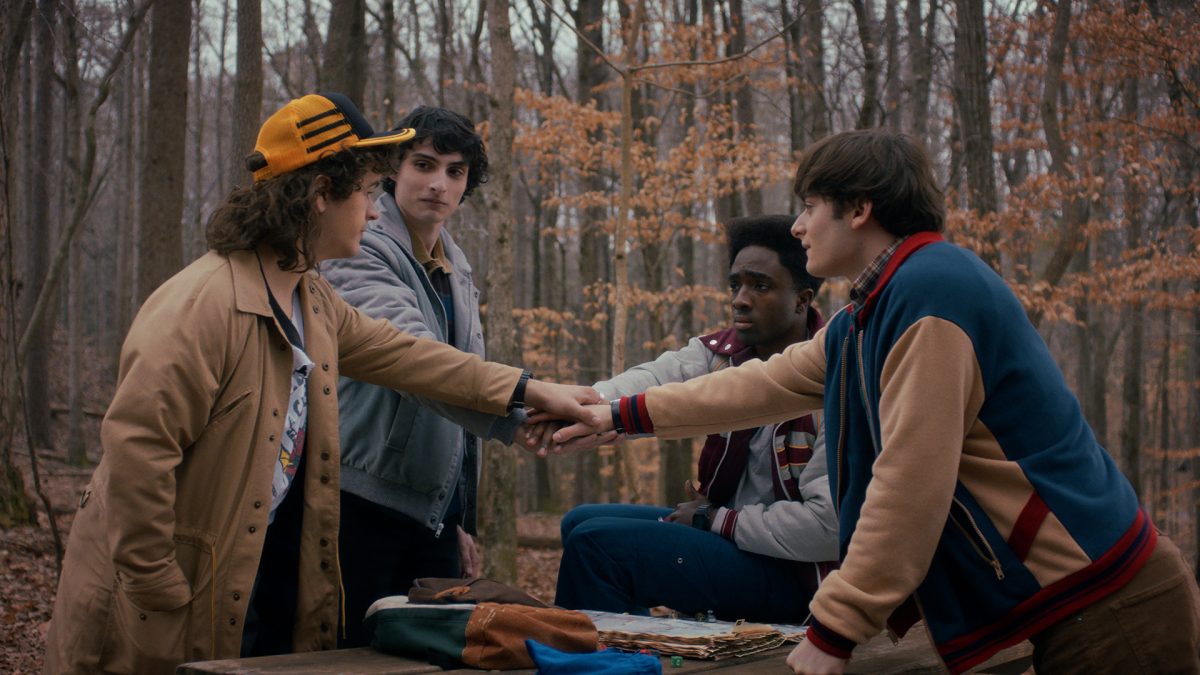
For having 10 hours and 33 minutes of runtime, the final season of “Stranger Things” did a whole lot of nothing.
After four previous seasons focusing on the main characters’ journeys being terrorized by Vecna and trying to understand The Upside Down in order to end their suffering, season five introduces a new arc centered around Holly Wheeler (Nell Fisher) and her young classmates as the other main characters finally get revenge on Vecna and save Holly.
As a long-time fan of “Stranger Things” who has been following the show and binging new seasons since the beginning, I expected this season to be centered around the characters that the fandom has grown to know and love over nearly 10 years. While Holly is the younger sister of two beloved main characters, Mike (Finn Wolfhard) and Nancy Wheeler (Natalia Dyer), this season was the first time the audience got to know her.
Making Holly a main character, if not the sole main character of the final season, was a horrible idea. Why should I care about this new character when I don’t know her at all? Even through near-death experiences, it was hard for me to feel for her. She also had almost zero character development and did not grow as a character.
It would have made so much more sense to focus on the characters that we have seen on screen for all these years, characters who have more to lose and a higher emotional connection with the audience. Even using Erica Sinclair (Priah Ferguson) in place of Holly would have been a better option, as she is also the little sister of a main character and audiences have watched her grow up and have a personality on screen. I don’t understand why the writers allowed Holly to take up so much valuable screen time that could have been utilized in better ways.
At first, I assumed that the writers introduced Holly to build up a character and make audiences care about her in order to write an emotional death into the season as they have done many times before, specifically with Eddie Munson (Joseph Quinn) in season four. I soon realized that the writers had become too cowardly to kill anybody off.
I don’t support killing characters for mere shock value or ragebait. That’s not what I’m saying. However, refusing to kill characters in such a high-stakes and unrealistically dangerous universe like Hawkins is simply bad writing.
There were many scenes where deaths would be teased to scare the audience, but nothing would ever come of it. They would just get saved and everything would be unicorns and rainbows. It’s impossible to write a show like “Stranger Things” yet not include any stakes at all. Character deaths in general are not all for shock value; they are emotional and sometimes necessary for character arcs. You’re telling me that there was a gigantic monster threatening mankind that has been built up for four seasons and is assumed to be nearly impossible to kill, but nobody died in the fight? That’s a joke.
This season seemed to be written like a Disney Channel show. The audience has grown up, the actors have grown up, yet the script has not. The core audience is no longer tweens and teenagers. They can handle being scared, upset and emotional, and in fact, they want to be. If they wanted to turn on some feel-good television, there are other shows to choose from. “Stranger Things” is not supposed to be one of them.
Some of the acting is also comparable to Disney Channel level acting. The actors either delivered the performances of their lives, or they completely did not deliver. It felt like there was no in between. Joe Keery and Gaten Matarazzo as Steve Harrington and Dustin Henderson performed so well that I teared up. David Harbour as Jim Hopper made me emotional. However, actors like Millie Bobby Brown as Jane Hopper and Finn Wolfhard as Mike Wheeler pulled me out of scenes and made me laugh at how unreal their emotions felt.
The two hour long finale really pushed me over the edge. The ending did not make sense to me whatsoever. Certain things just didn’t add up, like how Max Mayfield (Sadie Sink) graduated high school and was fully able-bodied after being in a coma for two years and suffering horrible injuries after being trapped inside of Vecna’s mind. Mike’s explanation for Jane, otherwise known as Eleven or El’s ending, was poorly executed and felt like the writers were lazily going back on the only main character death.
In general, I was very disappointed with most of the characters’ endings. Vickie Dunne (Amybeth McNulty), one of the only queer characters in the show, was completely excluded from the epilogue and her character was not even given an ending. Will Byers (Noah Schnapp), another queer character, was given a watered-down ending where he meets a mysterious guy at a mysterious bar and the audience is supposed to believe that he simply gets over his crush on Mike, which had been building up for four seasons, without even having an adequate personal conversation about it. Hopper’s story ends on a high note that feels incomplete after all of the trauma his character was put through, as we don’t even see him grieve at all.
Although nothing could make me hate these characters that I grew up with and watched for a majority of my life, I wish that they were given the well-written endings that they deserved instead of the watered-down ones that they received.