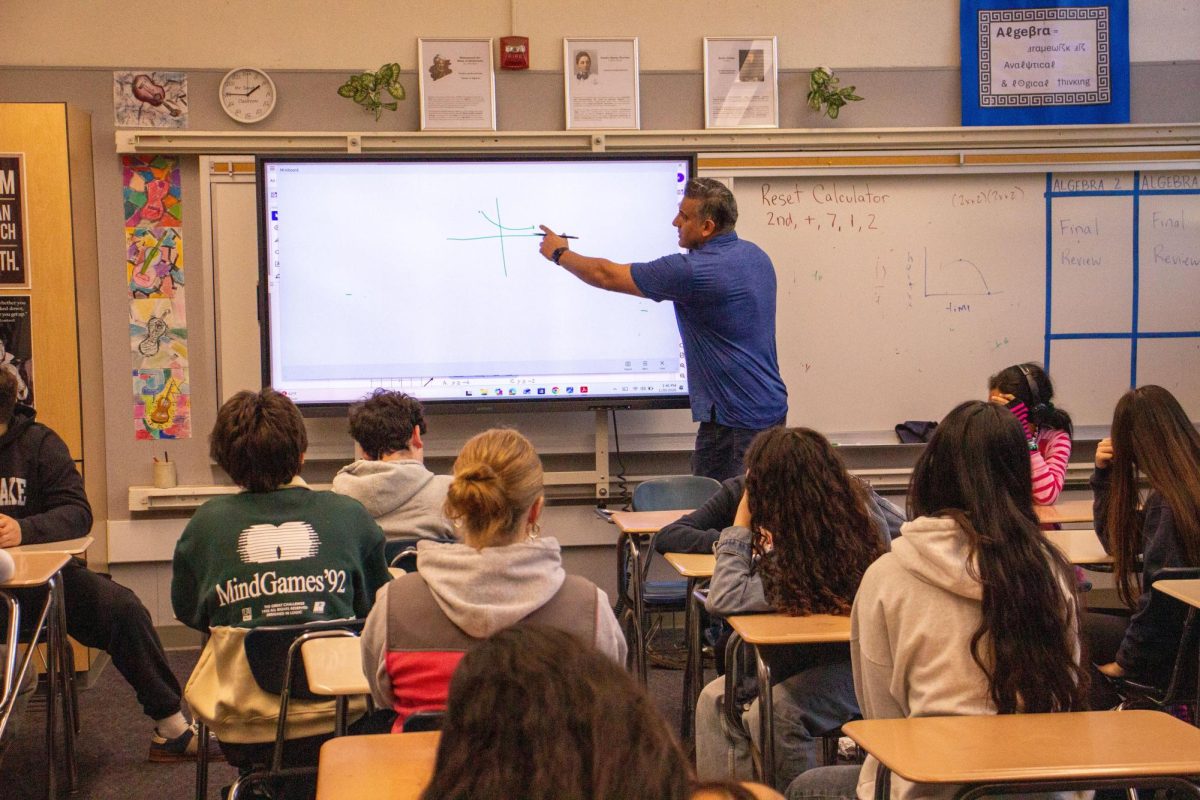
Moving to a new school can be a surreal experience, whether a student or teacher is making the switch. New schools come with new environments, new rules, new people and an entirely new campus, and it can be difficult for some to adapt to the new location. For a recent example, math teacher Ravi Sangha began teaching at Redondo this year, switching from a middle school in Torrance. He currently teaches Algebra 1 and Algebra 2.
“I hadn’t [taught Algebra 2] material in years, and when I found out I was teaching it, there wasn’t really a lot of time to prepare,” Sangha said. “I got to the point where I didn’t remember some material, so oftentimes I’d do problems on the board as I was relearning them myself.”
At first, Sangha was “intimidated” by the new environment, facing challenges such as the maturity difference between middle and high school students and a general lack of closer connections between staff members.
“I think my natural immaturity matched with the middle school kids, so they found my antics entertaining, whereas in high school, you have more strict criteria,” Sangha said. “So my juvenile shtick doesn’t really go over as well here when it [did] in those situations.”
Despite this minor setback, Sangha aims to teach math in a way that appeals to students and makes otherwise boring concepts enjoyable to learn, citing the importance of connecting concepts to students’ everyday lives.
“You give [a student] something like, ‘Here’s the Pythagorean theorem, apply it to this right triangle.’ That doesn’t seem very interesting,” Sangha said. “Especially for students that don’t have an interest in math, you have to come up with a way to make it appealing, like a reflection of their interests, their real lives, something that will grab their attention.”
Freshman Elise Wang, a student in Sangha’s first-period Algebra 2 class, says that his class “promotes a collaborative environment,” with group work being a major focus during class.
“[Sangha] has these whiteboards where he lets us work together on problems with friends and in groups,” Wang said. “I think it [creates] a very fun environment in the classroom.”
Despite his preference for teaching middle school when he first began at RUHS, his view eventually changed as he became more accustomed to the school’s community.
“At the beginning of the year, I preferred [to teach] middle school because there was more interaction with students. My classes were dead silent, thinking I was speaking a different language, but something has changed. The students have warmed up to me,” Sangha said. “There’s [also] a lot less behavioral problems in high school, which makes it a lot easier, because I can focus [more] on teaching instead of disciplinary action.”
Before he taught at any school, Sangha’s original inspiration for pursuing math education came from a particularly memorable experience in his own high school years following a difficult time in an advanced placement calculus class.
“My teacher at the time pulled me aside one day and told me I should give up on math. I passed [the class] by the skin of my teeth, [but afterwards] I didn’t think of myself as a good math student,” Sangha said. “Many years later, the stigma finally wore off, and I thought that maybe I’d give this another try because I felt like I had something to prove to myself. I started studying math in graduate school, and soon after I changed my course of study from math to teaching. I want to be the teacher that I always wished I had.”