
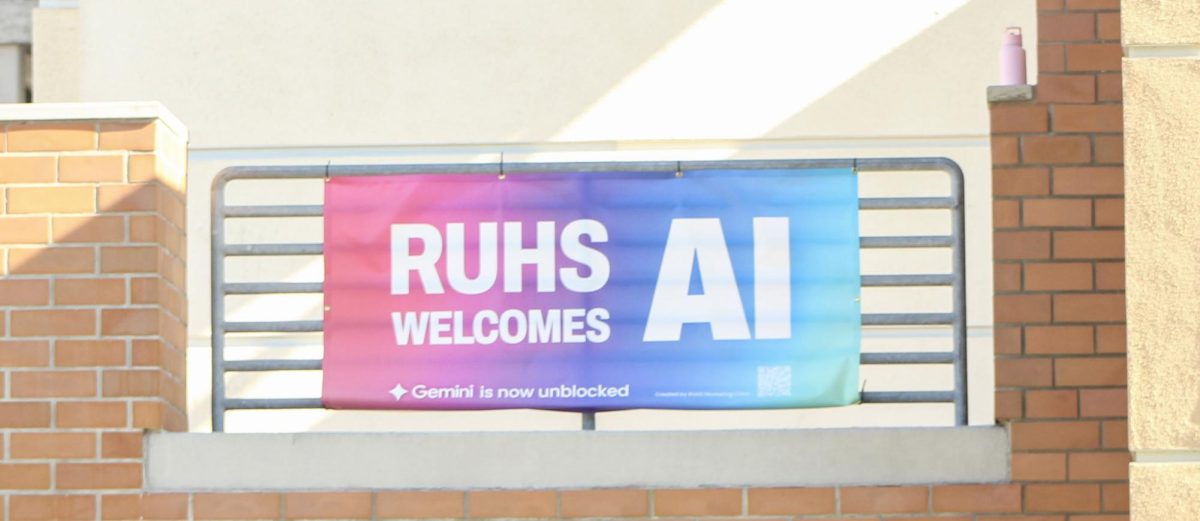
As students arrived at RUHS, they were greeted by a message some would not have expected: “R U Ready for AI?” While emblazoned upon flyers, yard signs and banners across campus that appeared seemingly overnight, these words are actually part of the months-long district-wide initiative to determine what role artificial intelligence (AI) can and should play in our schools. As RBUSD Chief Technology Officer, Susuna Garcia was a part of many steps in the process that culminated in Gemini, an AI chatbot owned by Google, becoming unblocked on district managed computers.
“We know that AI is here and it’s revolutionizing education,” Garcia said. “One of the things that RBUSD does is look at what’s happening in the world and what that means for student success. Even though we’re engineers, we’re technicians and other different roles in the Information Technology (IT) department, at the end of the day, every decision that we make, whether it’s hardware, software, artificial intelligence or digital citizenship, all revolves around how we quantify students’ success to what’s happening in the world. How do we build guidelines? How do we build a system where we are preparing every single student for success?”
First, Garcia and Superintendent Dr. Nicole Wesley participated in an education technology innovation group where they had the opportunity to visit the headquarters of major IT corporations including Apple, Microsoft, Samsung and Amazon. Here, the two heard from “all” of the corporations that AI skills were sought in their employees.
“We came back and said, well, what are we doing to prepare our students?” Garcia said. “What are we doing to make sure that there’s equity in terms of access to AI while also ensuring that we have Children Internet Protection Act (CIPA) compliance, which means we are ensuring the AI that we are allowing does meet the age and the data privacy guidelines to allow it to be accessible to all of the student populations? That’s kind of where it all started.”
Another person heavily involved in this process from the beginning is Merlan Land, who serves as a Technology Integration Teacher on Special Assignment (TOSA) and teaches the Marketing and Finance class that created the “R U Ready for AI?” campaign. Land also had the opportunity to attend conferences about AI for educators with the other TOSAs. One of the first that they attended was about equity in AI use, which Land notes was important to them in their decision to unblock Gemini.
“We live in a privileged area, and Redondo is great because we have diverse incomes,” Land said. “There are students that already have AI at home and can just go ahead and buy it, but what about the students that can’t? Just because they can’t afford it doesn’t mean that we as a school shouldn’t be teaching them how to use it appropriately because it’s not just going to be [used] here at your school. It’s going to be in college, and it’s definitely going to be in your work. A future job is expecting you to know how to use it and how to use it ethically.”
After gathering this input from corporations and AI experts, Garcia worked with Land and two other Technology Integration TOSAs last spring to set up Redondo’s Education with AI Leadership (REAL) Team. The committee included parents, teachers and administrators from schools across RBUSD, but to Land, “one of the most important” perspectives that they included was students. The team received over 100 applications.
“I was taken aback when we got all the applicants,” Garcia said. “Obviously, we can’t host over 100 people, but that just goes to show that people care about what is happening in AI, what Redondo Beach is doing to help student success and how we are building guidelines and regulations to facilitate AI here.”
Once the REAL team was formed, one of their tasks was reviewing data from a survey that was administered to RBUSD students as part of a national research project with nonprofit Project Tomorrow and the Los Angeles County Office of Education. After four meetings, the district used the REAL Team’s feedback to create RBUSD’s AI Guidelines, which are available on the district website.
“We want to ensure we are pushing out AI ethics district wide, because just like there’s very good AI, AI can also be used for very malicious cyber threats, which we have seen,” Garcia said. “We just want to ensure that there’s policy guidelines, and that teachers and students are aware of both.”
After creating the AI Guidelines, the district decided to permit access to Gemini in particular because it offers “safe parameters,” according to Land, that prevent student data from being collected. The model does not learn from any information entered, which protects what Land calls their “number one” consideration: student privacy. To promote Gemini’s unblocking, Land’s Marketing and Finance class had what Land describes as the “incredible opportunity” to work in groups and create campaign plans that were eventually narrowed down to just three. Students presented each proposal to a panel that included Superintendent Dr. Nicole Wesley, Board of Education President Dan Elder, RUHS Principal Marvin Brown and Garcia.
“It was the hardest decision to choose one team,” Garcia said. “I wish I could have chosen them all. They were all very well prepared, they dressed up for the occasion and their content was great. It was a very good experience and I was definitely impressed. I know they were nervous, but I think they were able to very eloquently express their ideas.”
In the end, the panel selected the “R U Ready for AI” proposal and made it possible to create the physical materials. As a member of the Marking and Finance class, junior Connie Lee noted the panel’s “positive feedback” and the “usefulness” of a hands-on assignment, but took issue with the promotion of AI use via the campaign, representing another perspective in the AI debate.
“I don’t really like AI because I’ve seen a lot of videos on social media about how AI is affecting the world negatively,” Lee said. “No matter how much you tell people to use AI ethically and you teach them how to use it ethically, there are going to be people who don’t follow those rules, and it’s probably the majority of people, in my opinion.”
From reviewing survey responses to hearing voices from both sides in the REAL Team meetings, student input like Lee’s have been included in the considerations made by the district along this process.
“I think my role as a chief technology officer, even though it’s very technical, is that in every decision that we make, we ask ourselves, why are we making this decision?” Garcia said. “How does it impact student success? And some decisions are hard. Some decisions are easy. We get a lot of requests, whether it’s from teachers or students, and we always have to say, well, is this quantified in student success? Even though we are IT, every decision that we make is for student success. So, we definitely value the student voice and I’m open to any feedback. Even if it’s constructive criticism, I’ll take it. I love to hear what students have to say.”