
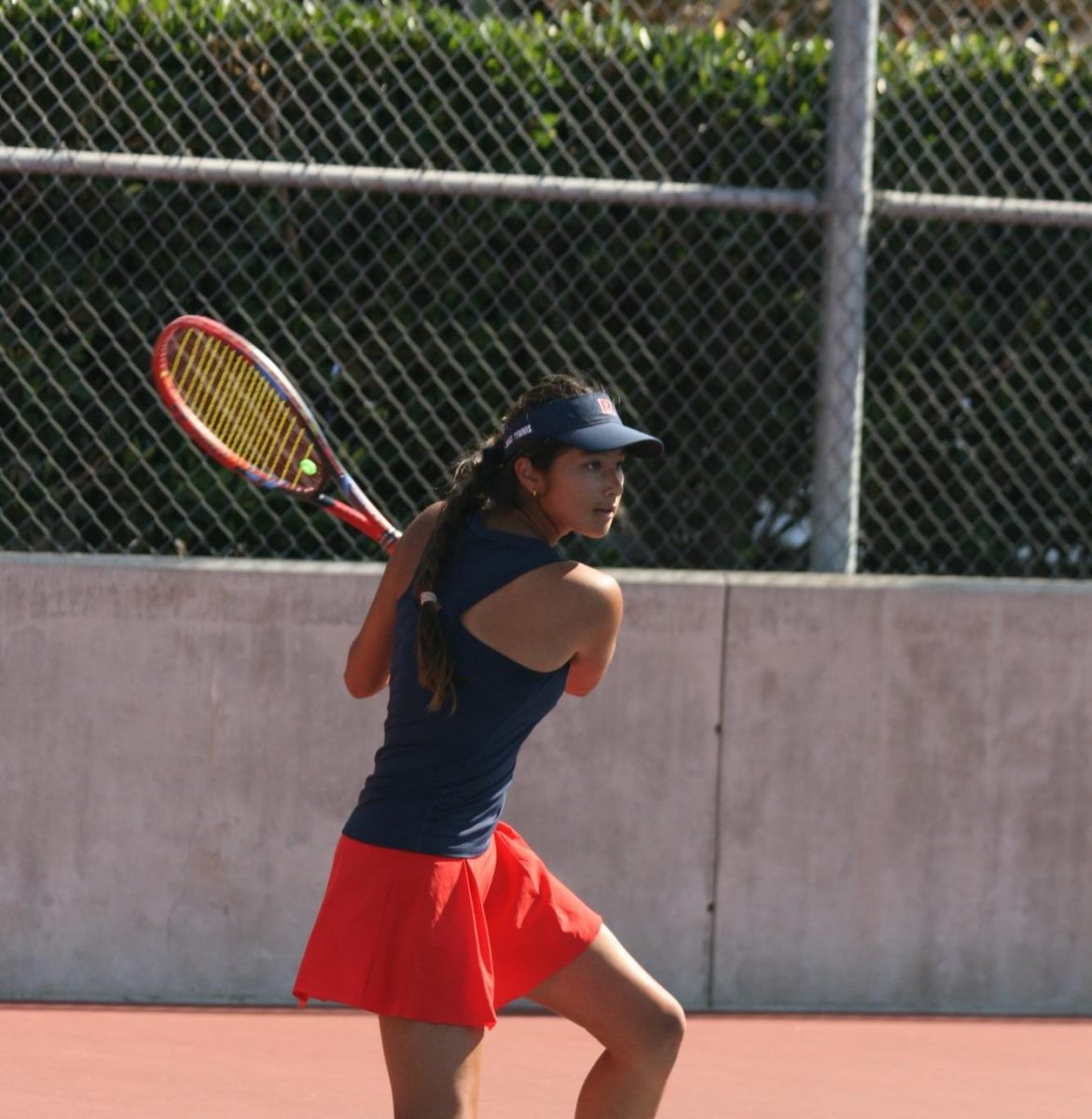
In the sweltering South Bay heat, the varsity girls tennis team waited anxiously for junior Kareena Yang’s singles match to be called. She had won Bay League last year as a sophomore, and this was her chance to prove it was more than just luck: it was discipline and a love for the game. When she finally won, her teammates ran onto the court, jumping up and down in celebration. As excited as Yang was, her victory felt like a responsibility she had to carry.
“I had a lot of stress on me since I won it last year, I guess it was definitely like I needed to do it. For me, it was more of a relief and just happiness when I won,” Yang said.
Her coach, Jordan Harris, was there when Yang won the title, but she saw more than just the girl who won the Bay League championship. She saw the athlete who she has worked with for the past three years, watching in real time as all the hours of Yang’s work paid off.
“I knew she was gonna win. She’s always willing to learn, and I definitely think she’s feeling very comfortable with where she is right now, but she can definitely go further, and I believe in her,” Harris said.
Yang’s personal standards are not the only ones she feels the need to live up to during the California Interscholastic Federation (CIF) competition. Her reputation of success has created expectations for both herself, her team and family.
“She handles it really well, honestly. Even now, when we’re in CIF, everybody’s leaning on her, knowing that she’s gonna secure three wins for us, for sure. She definitely also feels [the pressure] when her parents watch her because she wants to do well in her parents’ eyes,” Harris said.
But when Yang’s on the court, she tries not to let the pressure get to her. Despite her talent, confidence does not always come easy. She relies on knowing that every move she makes is well-practiced and lets herself use this to focus solely on running through the movements and play without her mind being overridden by outside factors.
“I actually don’t really think at all when I’m playing. Just staying calm and not looking like I’m stressed helps me to pretend I’m not stressed. Taking some time to reflect, and [readjusting] helps me to come back with a better mindset,” Yang said.
Over the last two years, Harris and Yang have built a close–knit coach–athlete relationship forged from mutual respect. Harris particularly appreciates Yang for her discipline, passion and ability to quickly connect with her opponents.
“She’s coachable, [which] is a treat, and she’s very nice. [I remember] when I was playing, I was always thinking that my opponent is my opponent. [Yang’s] over here [saying] she’s my opponent on the tennis court, but off the court, she’s my friend,” Harris said.
Her adaptiveness and skill help her not only in tennis, but also in life. They have given her the ability to think quickly on her feet and build trusting relationships with mentors, which are qualities that will undoubtedly support her in college and throughout her tennis career.
“You could tell her something, even in a match, [and] she would be like, ‘Okay, I’m gonna try it,’” Harris said. “Smart, creative, and athletic: that’s how I would describe her.”
Though Yang’s strategies are self-admittedly imperfect, they have brought her farther than her five-year-old self likely could have imagined when she was first introduced to the sport by her cousin. Now, tennis is a major part of her life, and it fuels her goals for the future.
“[The idea of] playing Division I motivates me a lot just because I’ve been playing [tennis] for so long now,” Yang said. “For it to all go to waste is something I don’t want.”